
Commercial Roof Inspections
Capability
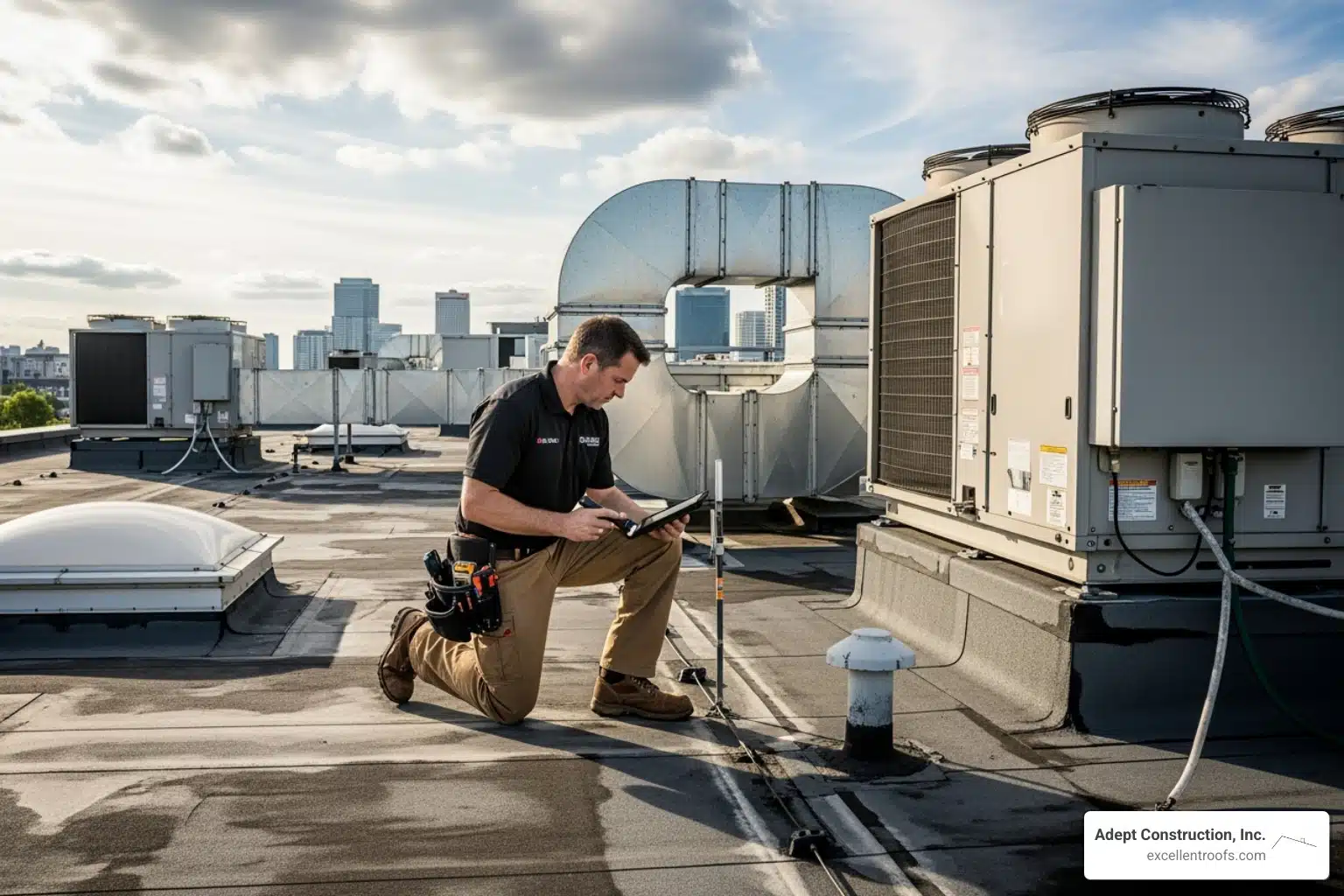
A roof walk without written output is just a conversation. Every inspection we run in Orlando produces a documented condition report, photo log keyed to the roof zone diagram, and a written priority list — tied to your capital cycle, not to ours.
The roof inspections we run for Orlando commercial buildings follow the same format whether the building is a 20,000 sq ft medical office in Lake Nona or a 400, near OIA. We walk every accessible area, document what we find in writing and photographs keyed to a zone diagram, and deliver a report the building owner or facilities manager can actually use — for capital planning, insurance renewal, manufacturer warranty compliance, or pre-sale due diligence.
What we are looking for is different in Central Florida than in most U.S. markets. Orlando's hurricane exposure means we are checking FBC wind-uplift attachment details — fastener patterns, perimeter edge metal, parapet flashing connections — in a way that would be overkill in a non-hurricane market but is baseline discipline here. Charley (2004), Irma (2017), and Ian's remnant bands (2022) each produced field failures in buildings that had been inspected and signed off by contractors who did not know what to look for in a hurricane-exposed environment.
Roof scope notes
We offer three inspection tiers: annual warranty-maintenance inspections for buildings in their manufacturer warranty period, scheduled capital-planning inspections for buildings approaching or past their original warranty term, and triggered inspections after significant weather events — the post-Ian and post-storm pattern we ran across Orange and Osceola counties in 2022 and 2023. Each tier has a defined scope, a defined deliverable, and a defined action output.
What the Inspection Documents
Zone diagram: Before the walk, we pull the building footprint and map it into roof zones — field, perimeter, corner — per ASCE 7 and FBC Chapter 15 definitions. This is the document that every photo and every deficiency finding gets keyed to. A deficiency report without zone references is useless when you try to schedule repair crews or present the finding to a manufacturer's warranty desk.
Membrane condition: We document membrane surface condition in each zone — granule loss on modified bitumen, seam integrity on TPO and EPDM, blister or delamination patterns, UV weathering grade. In Central Florida's high-UV environment, TPO membranes that are 8-12 years old often show surface crazing and seam opening that is not yet a leak but will be within two rainy seasons. We distinguish pre-failure from failure, and we provide the photo documentation to support the distinction.
Drainage: We walk every drain, check debris accumulation, confirm the drain is properly recessed below the surrounding membrane, and note any ponding patterns from the last significant rainfall if we can read them from the membrane surface or the drain ring deposits. Drain capacity is calculated against the roof area — Orlando's 100-year 1-hour rainfall intensity is 3.6 inches, which drives specific minimum drain sizing that we verify against what is actually on the roof.
Post-Inspection Report Format
The report we deliver is organized by zone and priority tier. Priority 1 items are active leaks or conditions where a significant rainfall event in the next 30 days will produce an interior water event. Priority 2 items are conditions that will produce a failure within the next 12 months under normal Central Florida weather patterns. Priority 3 items are documented conditions that need attention within the next capital cycle but are not imminent failures.
Each finding includes a photo reference keyed to the zone diagram, a description of the condition in plain language, the relevant FBC or manufacturer-warranty implication if applicable, and a rough cost band for the repair scope — so the building owner is reading one document, not three. We do not charge separately for the written report. If we walk your roof, you get the written output.
Inspection Cadence for Orlando Buildings
Buildings in their manufacturer warranty period should be inspected twice a year: once before the June hurricane season opens, and once after the October official close of season. This cadence produces a pre-season condition baseline and a post-season damage assessment, which is exactly what most manufacturer warranty desks require for warranty compliance. Missing a year of documented maintenance is the most common reason manufacturer warranty claims get contested.
Buildings out of their original warranty period should be inspected annually before hurricane season. At this point in a roof's lifecycle, the inspection is supporting capital planning, insurance documentation, and the decision timing on recover versus replace — not manufacturer warranty compliance.
After named storms or significant convective events — the classification we use is any rainfall event exceeding 3 inches in 24 hours or any wind gust event exceeding 60 mph at OIA — we recommend a triggered inspection within 60 days. The progressive damage pattern (membrane lifted at parapet, drain overloaded, repair from a prior event reopened under load) shows up in the first post-storm inspection but often closes before the interior leak event that would trigger an emergency call.
What does a commercial roof inspection cost in Orlando?
Inspection pricing depends on roof area and complexity. A straightforward flat-roof building under 50,000 sq ft runs in the range of $500-$1,200 depending on roof access complexity and the number of drains and penetrations. Buildings over 100,000 sq ft or with significant equipment density run proportionally higher. We quote before we walk. The report is included in the inspection fee — there is no separate charge for the written deliverable.
Can I use your inspection report for insurance renewal documentation?
Yes. The written report, zone diagram, and photo log we produce are formatted to support property insurance renewal documentation. Florida's commercial property insurance market has tightened significantly, and several carriers are now requiring current roof inspection reports for buildings over 15 years old. We have produced inspection reports for buildings whose owners were facing non-renewal and needed documented condition evidence.
Do you inspect buildings outside of Orlando proper?
Our regular inspection routes cover the full Central Florida metro — Downtown Orlando, Lake Nona, Winter Park, Maitland, Altamonte Springs, Sanford, Kissimmee, the International Drive corridor, the Disney Springs area, and the I-4 industrial and office corridors. We quote outlying locations on a case-by-case basis.
Schedule a documented roof inspection for your Orlando building.
We walk the roof, document conditions in writing and photos keyed to a zone diagram, and deliver a written priority report — for capital planning, warranty compliance, or insurance documentation.
Keep comparing the scope.

Commercial Roof Bid Coordination in
Structured competitive bid coordination for Orlando commercial roof projects — bid-package preparation, contractor qualification, scope leveling, and...
Commercial Roof Life-Cycle Cost Analysis
Life-cycle cost analysis for Orlando commercial roof decisions — total cost of ownership modeling for replacement, recover, and coating options...
Commercial Roof Maintenance Programs
Structured commercial roof maintenance programs for Orlando buildings — scheduled inspections, documented condition tracking, drain maintenance, and...