
Infrared Roof Scanning
Capability
Infrared thermography detects wet insulation and leak pathways that are invisible from the surface and interior. In Central Florida's high-solar environment, the infrared method works well — when the weather window is right.
Infrared thermographic scanning is one of the most effective non-destructive methods for detecting moisture in commercial roof insulation. The principle is straightforward: wet insulation absorbs heat during the day from solar loading and releases it more slowly after sunset than dry insulation does. In the post-sunset thermal window — typically the 2-4 hours after sunset on a day with full solar exposure — an infrared camera imaging the roof surface will show wet insulation zones as warmer-than-surrounding areas while the dry insulation has already cooled.
In Central Florida, the infrared method is effective during the dry season (November through May) when full-sun days followed by clear, still evenings are reliable. Orlando receives an average of 233 sunny days per year, but during the June-October rainy season — when most moisture decisions are being made urgently — the afternoon convective storm pattern means that reliable infrared survey windows can be weeks apart. We account for this in how we schedule infrared work and when we recommend nuclear gauge scanning instead.
Roof scope notes
Every infrared finding we report is confirmed with a physical core pull before we issue a recommendation based on that finding. Infrared images thermal signatures — which can be produced by conditions other than wet insulation, including reflective equipment, HVAC exhaust, or recent rainfall on otherwise dry insulation. We do not treat infrared as standalone evidence; we treat it as a targeting tool that guides us to where the cores should go.
How We Conduct the Infrared Survey
Pre-survey conditions: We assess the prior day's weather — minimum 4 hours of full sun to charge the roof surface, no rain in the preceding 12 hours, wind speed below 15 mph during the survey window. In Central Florida, we track the National Weather Service forecast for the Orlando metro starting 3-4 days before the scheduled survey and confirm go/no-go on the morning of the survey. If conditions are not adequate, we reschedule — an infrared survey run in marginal conditions produces unreliable data.
Camera and methodology: We use a calibrated infrared camera with thermal sensitivity adequate to distinguish 0.5°C differentials at the roof surface temperature range typical of a Central Florida post-sunset period (typically 85-100°F surface temperature in summer, 65-80°F in winter). The camera is mounted on a mast or used handheld depending on roof access. We image the full roof area in overlapping passes to ensure complete coverage, and we georeference the images to the zone diagram so each anomaly has a documented location.
Core confirmation: Following the infrared scan, we mark and pull cores at the anomaly locations — typically the 3-5 warmest spots plus any additional locations that appear anomalous relative to the surrounding field. The cores tell us whether the thermal signature corresponds to wet insulation, a prior repair, a buried detail, or another condition. We document both the infrared image and the core result for each location in the report.
Infrared After Hurricane and Storm Events
Post-storm infrared scanning has a specific application for Orlando buildings after significant weather events. When Hurricane Ian's remnant bands moved through Orange County in late September 2022, the storm left significant rainfall across the metro — and many roofs that had minor pre-existing deficiencies experienced accelerated moisture infiltration under the sustained rainfall and wind load. In the weeks after Ian, the dry-season pattern returned quickly, creating good infrared survey windows in October and November.
Buildings that ran post-Ian infrared surveys in that October-November window were able to document new moisture infiltration — separate from the visual storm damage — that supported insurance claims and warranty claims. Buildings that did not run post-storm surveys had a harder time distinguishing new event-related damage from pre-existing conditions when claims were presented months later. The post-storm infrared survey, run within 60 days of the event during a good weather window, is now part of our standard post-storm protocol for buildings on our maintenance programs.
The Florida hurricane season runs June 1 through November 30 officially. In practice, the most damaging systems — Charley, Irma, Ian — have all moved through Central Florida in the August-October window, after which the weather pattern typically transitions to a drier, cooler pattern with good infrared survey conditions. Planning for a November post-season survey as standard practice gives us the first good opportunity to assess event-related moisture after the season closes.
What Infrared Does Not Detect
Infrared thermography is a moisture detection tool, not a general roof condition assessment. It does not detect membrane deterioration that has not yet produced moisture infiltration, it does not assess fastener pullout strength or FBC wind-uplift compliance, it does not evaluate drain conditions, and it does not identify flashings that are mechanically compromised but not yet leaking. The infrared survey is always paired with a visual inspection and used as a complementary tool — not as a substitute for the full condition assessment.
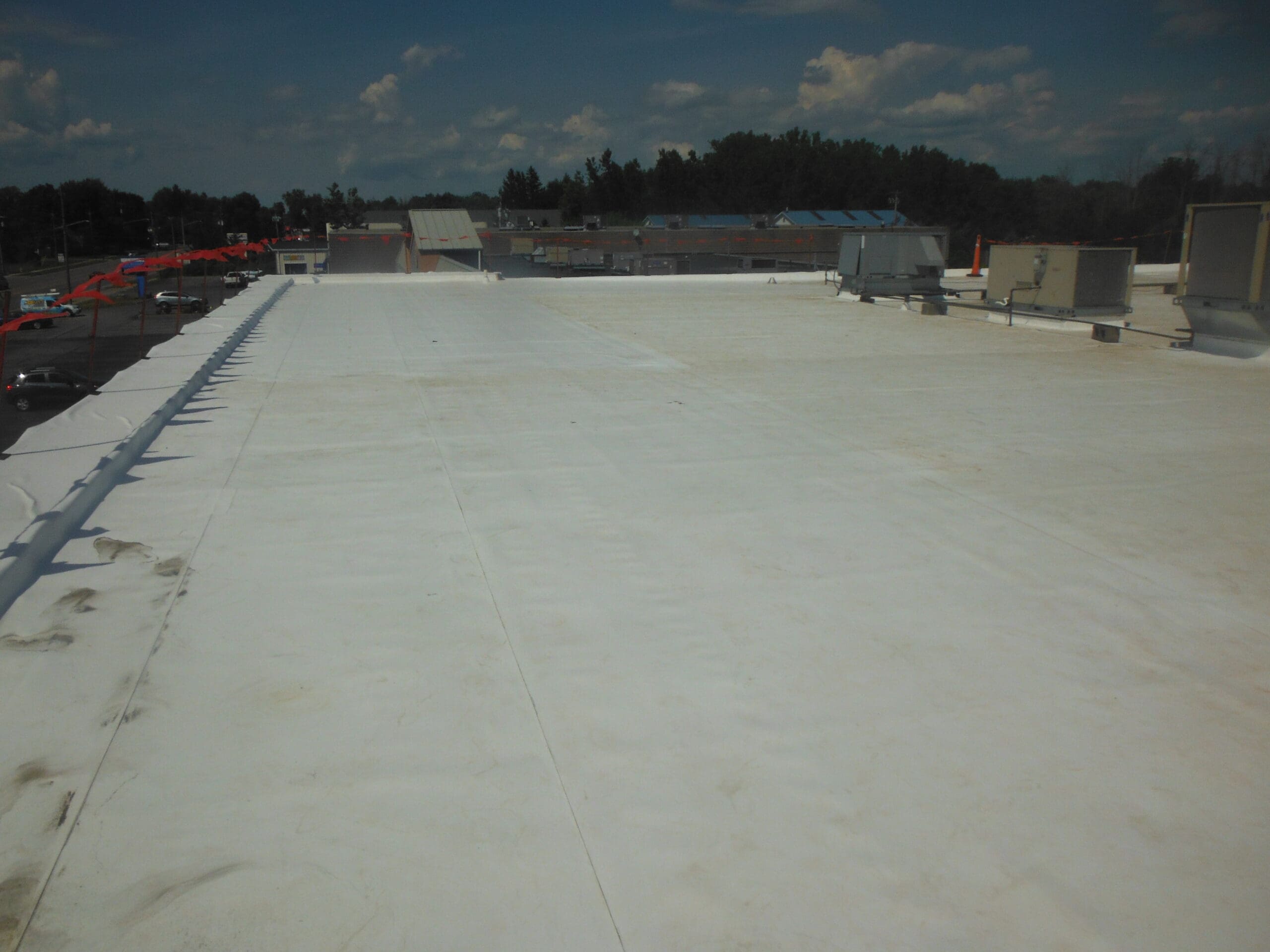
Buildings with reflective membranes (white TPO, white PVC) present a scanning challenge because the high reflectivity of the membrane surface can reduce the thermal differential that makes wet insulation detectable. We adjust our scan timing and methodology on highly reflective membranes, and we are conservative about the confidence level on infrared findings on these surfaces — more cores, lower threshold for confirmation.
What is the best time of year to run an infrared scan in Orlando?
March through May and November through January are the most reliable windows for infrared surveys in the Central Florida area. These months combine adequate solar loading with clear evening skies and low wind speeds. June through October produces good solar loading but the afternoon convective storm pattern interrupts the clear-evening requirement frequently. We schedule infrared surveys in these windows and use nuclear gauge scanning when the rainy season creates an urgent need outside the optimal window.
How accurate is infrared roof scanning?
In good survey conditions, infrared thermography identifies wet insulation zones with an accuracy that is generally within the 10-15% of roof area range for saturation extent. It is a mapping tool, not a precise measurement. We confirm all findings with cores and provide a confidence range rather than a precise percentage in our reports. The nuclear gauge survey provides more precise mapping for large-area saturation assessment; infrared is better at identifying discrete leak pathways and localized moisture patterns.
Can infrared scanning find the source of an active leak?
Sometimes. Infrared will identify where moisture is in the insulation, which is often downstream of the actual membrane breach — water travels horizontally in insulation before it reaches the interior. Identifying the location of the wet insulation narrows the search for the membrane breach, which we then confirm by physical examination of the membrane at and upslope of the wet zone. Active leaks where the source is unknown are a good use case for combining infrared with a physical inspection.
Do you do aerial infrared surveys with drones?
We assess aerial drone infrared surveys on a case-by-case basis. For large, simple roof planes without significant equipment, drone infrared can cover area efficiently. For roofs with dense HVAC equipment, skylights, or complex geometry, the ground-level handheld survey gives us better angle control and closer proximity to the surface. We use whichever method produces better data for the specific building.
Keep comparing the scope.

Commercial Roof Bid Coordination in
Structured competitive bid coordination for Orlando commercial roof projects — bid-package preparation, contractor qualification, scope leveling, and...
Commercial Roof Inspections
Documented commercial roof inspections for Orlando-area buildings — condition reports, drain assessment, FBC compliance status, and photo logs keyed...
Commercial Roof Life-Cycle Cost Analysis
Life-cycle cost analysis for Orlando commercial roof decisions — total cost of ownership modeling for replacement, recover, and coating options...